The Equipment Is Arriving. Is Your Data Center Site Ready?
How planning temporary infrastructure early can prevent storage problems from becoming schedule problems
The delivery schedule says the equipment is arriving Monday.
The permanent building is not fully enclosed. The designated staging area is already full. Rain is in the forecast, and the materials cannot be left exposed. There is no time to begin a lengthy building project, but sending the delivery off-site will add transportation, handling, labor and another layer of coordination.
Suddenly, the team is not solving a storage problem. It is trying to prevent a logistics problem from becoming a schedule problem.
This is not the position any data center construction team wants to be in. Yet on large, fast-moving projects, it is easy for temporary infrastructure to be treated as a secondary concern. The permanent facility receives most of the attention, while the space needed to support construction is addressed only after materials begin arriving and the site becomes constrained.
By then, the available options may be limited.
The better approach is to plan ahead.
A temporary-space problem rarely stays temporary
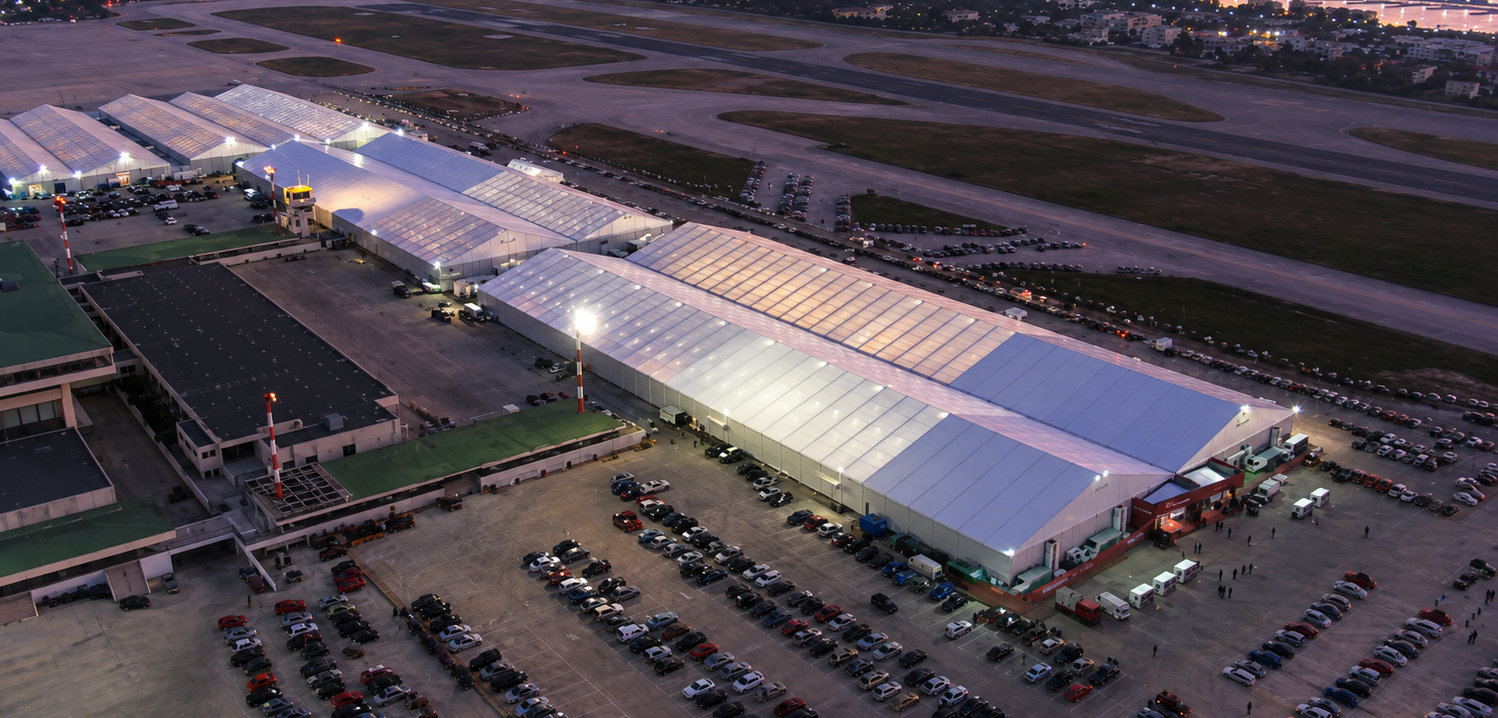
Data center projects depend on carefully coordinated deliveries, trades and installation sequences. One activity affects the next. One delayed delivery can affect several teams downstream.
Now consider what happens when a critical shipment arrives without an appropriate place to go.
The project team may be forced to choose among several less-than-ideal options:
- Leave valuable materials or equipment exposed to weather
- Move the shipment to an off-site warehouse
- Rent space that was not included in the original plan
- Delay delivery and risk affecting the installation sequence
- Rush to secure a structure without enough time to evaluate the right size, location or engineering requirements
Each solution may address the immediate problem, but it can also create new costs, new risks and new coordination requirements.
What started as a need for covered storage can quickly affect material flow, crew productivity, site access and the construction schedule.
Do not wait until the trucks are on their way to decide where everything will go.
Do not discover engineering requirements too late
Imagine selecting a structure, assigning it a critical role in the project schedule and then learning that it does not meet the requirements for the site or intended use.
That is another preventable bind.
Structural performance should be supported by engineering documentation, not implied by a marketing claim. The applicable codes, wind conditions, snow loads, site conditions, duration and intended occupancy should be discussed before the structure is promised to the project.
Anchor offers engineered Clear Span and relocatable warehouse structures with configurations and options selected around specific project criteria. Teams should ask for the documentation and verify which requirements apply to the location, product and use.
These conversations are much easier to manage early, when there is still time to make informed decisions.
Anchor understands what it takes to keep a site moving
As an experienced manufacturer of temporary Clear Span and relocatable warehouse structures, Anchor understands the full process, from early planning and engineering through production, delivery and installation.
We work with construction teams to evaluate the space, site conditions, access requirements and project timeline. Whether the need is short-term storage and staging or a longer-term Warehouse solution, we help identify the right structure for how the site needs to perform today and in the future.
Plan the space before you need it.
Learn more about Anchor construction storage and staging solutions
Email Anchor
